Is South Africa’s Economic Crisis Misdiagnosed? Why Digital Business and AI May Be the Real Solution
A bold reflection on South Africa’s economic narrative, exploring how digital business and artificial intelligence could reduce corruption, improve efficiency, and unlock inclusive growth — through lived experience, practical examples, and unapologetic optimism.
Mimi Masala
12/23/20254 min read
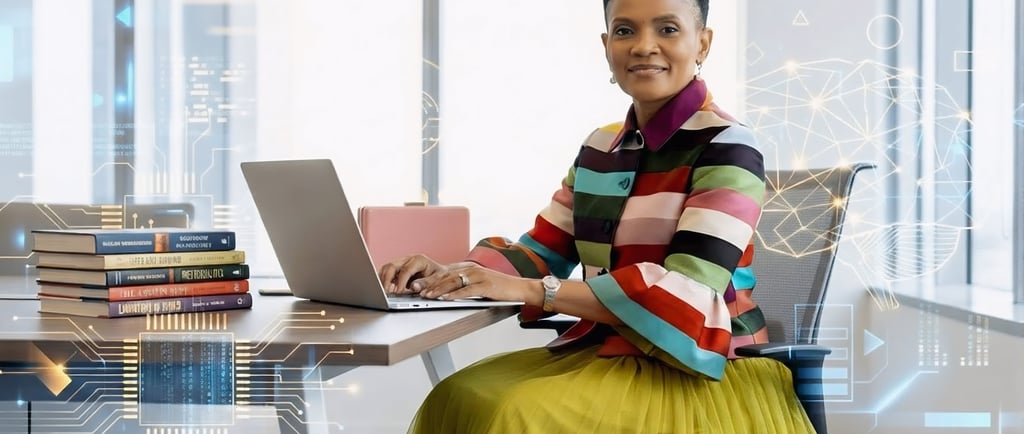
The dominant narrative about South Africa’s economic decline often points to government failure and corruption as the primary culprits. While corruption is real and damaging, the question we should be asking is whether this narrative is incomplete, or even misplaced.
More importantly: are we ignoring obvious, actionable solutions?
We have seen this country reach breaking point before. During the electricity crisis, it was only once the pain became unbearable that the private sector was allowed, even encouraged to intervene. Solutions followed. Innovation followed. Progress followed.
The question is: are we not there yet? Because it certainly feels like we have surpassed the burning point.
My Accidental Deep Dive into AI
During 2025, I immersed myself deeply in the digital space specifically Artificial Intelligence (AI). This journey didn’t begin out of curiosity, but necessity. Two years ago, I was desperately searching for ways to digitise informal businesses in townships and underserved areas across South Africa.
Once AI awareness exploded, I decided to test how far I could push the technology and I’ll admit, I had fun. I often joke that if my GPT went to sleep tomorrow, I might panic.
But beneath the humour lies a serious truth: AI is not a luxury. It’s infrastructure.
Publishing a Book in 12 Hours — and What Stopped Me
On 13 December 2025 at 10:30am, I challenged myself to publish a book within 12 hours. By 4pm, the manuscript was written, typeset, and the cover and back page designed. I know the exact time because I was racing against something equally important, my local street food vendor, who closes at 5pm. I had planned to reward myself with steamed bread and tripe.
The process didn’t stop because of creativity. It stopped because of systems.
The ISBN
I could have proceeded with Amazon’s ISBN, but that would restrict distribution to one platform, and anyone who knows me knows I am obsessive about intellectual property ownership.
The National Library of South Africa (NLSA) was closed for the weekend. Monday arrived with an auto-reply: my trusted librarian was on leave. Previous experience told me this could take weeks.
Using LinkedIn Premium, I reached out directly to leadership at the NLSA. To their credit, they intervened, and I recommended digitisation as a long-term solution, which I hope they will seriously consider. Globally, this is standard practice.
At one point, I even considered purchasing an American address just to secure an ISBN immediately. With it being a public holiday on the 16th, I eventually received my ISBN on the 17th.
This was not a planning failure. Ideas are not planned. In a digital economy, spontaneity is competitive advantage. If a client wants a book within 24–48 hours, the system should enable that, not block it.
Can AI Reduce Corruption? A Simple Observation
In a discussion with one of my sons, who plays an integral role in my digital businesses, he made a surprisingly simple observation:
If AI and digital systems were deeply integrated into government and corporate processes, corruption would largely be eliminated.
· Digital systems leave trails.
· They reduce human discretion.
· They are harder to intimidate.
And to be clear, corruption is not a government-only problem. It takes several parties to tango.
To also frame AI as “job replacement” is lazy thinking. Increased efficiency leads to increased economic activity, and that creates jobs. I have not even begun the medical advancement in AI.
This is why I offer digital upskilling courses. Instead of waiting to be retrenched, upskill yourself now. At $9.99 per course, there is no excuse to cry foul. The real question is:
What are you doing with your discretionary spend, Netflix or upskilling? Or better yet, in the South Asfrican context, ‘umjolo’! Your GPT should be able to decipher that word.
👉 Explore over 150 courses at digiwise.co.za
The Book: The Silver Edge
Yes, I did eventually publish the book: The Silver Edge: Hard-won Sales Lessons from Ryan Serhant
📘 Available now on Amazon Kindle
👉 https://www.amazon.com/Silver-Edge-Hard-won-Lessons-Serhant-ebook/dp/B0G87SF9NF
The hard copy will be released on 1 January 2026 — deliberately so. On New Year’s Day, I’ll be able to say: “I published a book this year while on holiday in Dubai.” 😁
Before downloading the book, I encourage you to sign up as an Amazon Affiliate. Earn from your recommendations, not only my books, but any books you already share with friends, family, or colleagues.
In 2026, earn from your spend. That’s digital business, authentically shared value.
Publishing Is the New Power Move
I’ve since published another book, one I intend to collaborate on with my favourite retailer, Woolworths.
If you have the energy to get over yourself in 2026 and publish a book, holla.
Don’t think cost, think audience. If you believe you can pre-sell 1,000 copies, you can afford it. We carry the upfront risk. We’ll assess whether your story is compelling — most are.
What we’re not interested in is “maybe next year.” At the current rate of transformation, your story will lose relevance if you wait.
Write the book now. Then write another.
My Commitment
By the end of 2026, I intend to have no fewer than 20 books published.
Each book will have:
A publication manager
Course material
Podcasts
Music adaptations
Corporate speaking engagements (local & global)
That’s 20 jobs created — minimum. Each income potentially supporting four family members.
And who says AI destroys jobs? For me, every book equals employment.
Over to You
Do you believe digital business and AI can:
Reduce corruption?
Improve efficiency?
Accelerate economic inclusion?
I’d love to hear your thoughts.
Contact
Reach out for collaborations or questions
Phone
mimi@mimimasala.com
+27-82-777-5156
© 2025. All rights reserved.
Designed by Bougainvillea Studios