Silence Is Not a Strategy: Why Ignoring Customers Is Costing Companies Their Reputation
In an age where transparency and responsiveness define corporate credibility, silence has quietly become one of the most dangerous “strategies” in business. This blog unpacks a real customer experience that raises a far broader question: when companies ignore legitimate customer queries, are they exercising strategic restraint — or revealing systemic arrogance and a breakdown in customer-centric culture? We explore the reputational, legal, and financial risks of silence, the false comfort some organisations derive from ignoring complaints, and why escalation to regulatory bodies often becomes inevitable when dialogue fails. More importantly, we challenge business leaders to reconsider whether silence protects their brand — or actively erodes it. For executives, PR professionals, and customer experience leaders, this piece is a call to re-humanise corporate communication and recognise that in the digital era, what you fail to say may matter more than what you do.
Mimi Masala
1/20/20263 min read
Silence Is Not a Strategy: Why Ignoring Customers Is Costing Companies Their Reputation
In a world where brands invest millions in visibility, positioning, and customer experience, it is baffling that some companies still adopt silence as a communication strategy — especially when faced with customer complaints or legitimate enquiries.
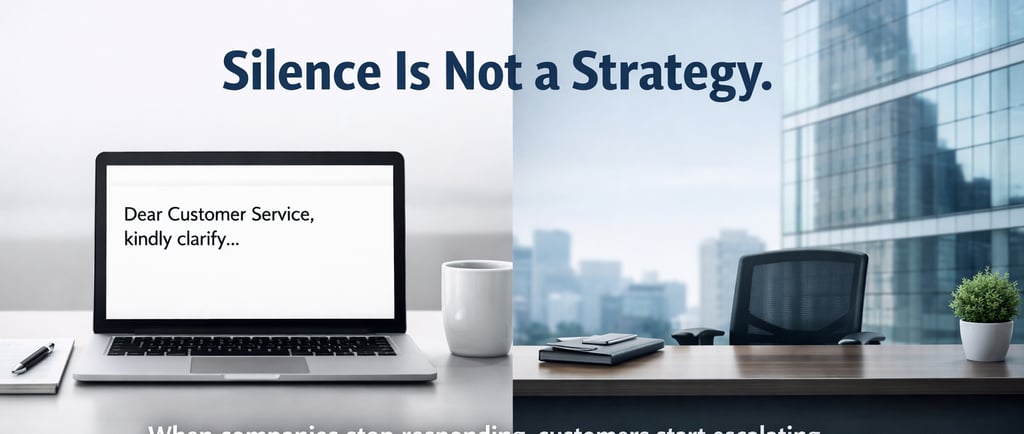
Recently, I reached out to an organisation to query why I had been charged for a specific item. It was a simple request: clarity, transparency, and fairness. Instead of a response, I was met with… silence.
Not “we are investigating.”
Not “we acknowledge receipt.”
Not even a templated auto-response.
Just silence! Ironically, the next step is not silence at all. The next step is escalation to the Consumer Council. Once that happens, the same organisation will be legally compelled to respond, and the outcome will most likely be documented and shared publicly. A situation that could have been resolved quietly, professionally, and with dignity now risks becoming a reputational issue.
So the question becomes:
Is silence really worth the cost to brand trust and public perception?
Silence Is Not Neutral — It Is a Message
When a company ignores a customer, it is not being passive. It is communicating something very clearly:
· You are not important enough to respond to
· Your concern is not a priority
· We believe we can afford not to care
In today’s environment, silence is not a neutral act — it is an active decision that speaks volumes. Customers may forgive mistakes, billing errors, system glitches, or delays. What they rarely forgive is being ignored.
Silence suggests arrogance, not confidence.
It suggests disregard, not authority.
The False Economy of Ignoring Customers
Some companies operate under the illusion that responding to complaints is costly — time-consuming, legally risky, or operationally inconvenient. In reality, the opposite is true.
Ignoring a customer:
· Increases escalation
· Invites regulatory involvement
· Exposes the brand to public scrutiny
· Multiplies reputational risk
· Costs far more in damage control later
A single unresolved complaint can evolve into:
· A case before a regulatory body
· A viral social media narrative
· A negative Google review footprint
· A story that becomes “the brand experience”
The cost of a response email is negligible.
The cost of silence is exponential.
Customer Service Is Not a Department — It Is a Culture
When companies fail to respond, it often points to a deeper issue: not systems, but culture.
This is not merely about frontline inefficiency. It reflects:
· How leadership views customers
· Whether accountability is embedded
· If service is genuinely valued
· Or merely marketed
If silence is tolerated internally, it becomes institutionalised. It becomes “how we do things here.” And when that happens, the brand slowly drifts from being customer-centric to being self-centric.
That is a dangerous transition.
Is Arrogance Built Into Some Corporate Structures?
It is worth asking: Are some companies structurally designed to be dismissive?
In some corporate environments:
· Power is centralised
· Customers are viewed as transactional
· Complaints are seen as irritations, not insights
· Compliance replaces care
When scale increases and empathy decreases, arrogance can creep in quietly. Not as overt rudeness, but as indifference. And indifference is far more corrosive than bad service.
Arrogance in corporate systems is not always loud. Sometimes it is simply… silence.
Why Companies Exist: A Reminder
At the most fundamental level, companies exist to:
· Serve a market
· Solve a problem
· Deliver value
· Build trust
Not to dominate customers. Not to silence them. Not to outlast them through inertia.
Every brand that forgets this begins a slow erosion of relevance.
You do not build loyalty through legal compliance alone. Loyalty is built through responsiveness, respect, and relationship.
The Irony of Forced Responses
What makes the silence strategy even more ironic is, once a matter reaches a regulator, the company will respond. Not because they suddenly care, but because they are forced to.
At that point:
· The tone changes
· The urgency appears
· The legal teams engage
· The narrative becomes defensive
Yet all of this could have been avoided with a simple response when the customer first asked. Silence delays resolution, but it never avoids it.
In the Age of Transparency, Silence Is Risky
We live in an era where:
· Screenshots are permanent
· Emails are receipts
· Silence is traceable
· And reputations are fragile
Consumers are more empowered, more informed, and more connected than ever before. A company that relies on silence is relying on an outdated power imbalance that no longer exists.
Today, reputation is shaped less by advertising and more by behaviour. Silence is behaviour.
A Better Strategy: Responsible Responsiveness
The alternative to silence is not over-exposure, over-apology, or over-communication. It is simply:
· Acknowledging receipt
· Communicating timelines
· Being transparent
· Treating customers as stakeholders, not nuisances
This is not PR spin.
This is operational maturity.
A company that responds does not weaken its position.
It strengthens its credibility.
Final Thought: Silence Is a Choice — And So Is Respect
Every time a company chooses silence, it is choosing a posture towards its customer.
And that posture is either:
· “We value you”
or
· “We don’t need you enough to care”
In a competitive market, that is not a neutral choice, it is a strategic one. Increasingly, it is a costly one.
Contact
Reach out for collaborations or questions
Phone
mimi@mimimasala.com
+27-82-777-5156
© 2025. All rights reserved.
Designed by Bougainvillea Studios