The Skills Development Blind Spot: How Neglecting Training Silently Stalls Business Growth
A reflection on how neglecting skills development quietly undermines sales, execution, and business growth — and why organisations that fail to invest in their people inevitably stall, stagnate, and lose relevance.
Mimi Masala
1/15/20262 min read

The Skills Development Blind Spot: How Neglecting Training Silently Stalls Business Growth
Yesterday, I had a conversation on skills development in the workplace that stopped me in my tracks. Not because it introduced a new concept, but because it surfaced something many organisations — myself included — often overlook.
Companies have quietly abandoned skills development, without fully appreciating its direct correlation to sales performance, execution, and long-term business growth. Training has become transactional. Fast. Project-specific. Reactive. And that is precisely the problem.
When Training Is Reduced to “Speed Learning”
In many organisations today, training only happens when a new system is introduced or a specific project must be implemented. This “just-in-time” or “speed training” approach is meant to save time, but it often produces the opposite effect.
What follows is predictable:
· Poor implementation
· Limited ownership
· Low adoption
· Frustration from line staff
· Resistance from middle management
Why? Because training is seen as a disruption, not a strategic investment. Mid-management, under pressure to deliver daily targets, often views training as something that gets in the way of “real work.” Line staff sense this immediately. When leadership does not prioritise learning, neither will the organisation.
This is not a people problem.
It is a leadership signal problem.
A Simple Test of Commitment
There is a very quick way to assess whether an organisation truly values skills development.
Ask a unit manager: “What is your training budget as a percentage of sales?”
If the response is vague, hesitant, or non-existent, there is usually a direct correlation to:
· Underperformance
· Low innovation
· High staff turnover
· Stagnant growth
Training that is not measured, budgeted, or tracked is not a priority — no matter how often it appears in strategy decks.
Why Employees Resist Training
The second major insight from the discussion was equally revealing.
Employees resist training when they do not see what’s in it for them.
If training does not lead to:
· Career progression
· Increased responsibility
· Recognition
· Or improved earning potential
…it will always feel like an imposition.
People do not resist growth. They resist irrelevance.
Why McDonald’s Gets It Right
This is where companies like McDonald’s continue to outperform expectations.
At McDonald’s, skills development is not optional — it is embedded into the DNA of the organisation. Employees understand that learning leads somewhere. The concept of a degree in Hamburgerology may sound amusing, but it represents something deeply serious: a clear pathway from entry-level to leadership.
A crew member can progress through structured training into management, and in some cases, into executive leadership. Very few organisations can genuinely claim this level of internal mobility.
Training at McDonald’s is not just about competence. It is about possibility.
The Growth Connection Most Leaders miss
Here is the uncomfortable truth: Companies that do not grow, stagnate. And companies that stagnate, eventually perish.
Growth requires:
· New thinking
· New skills
· New capabilities
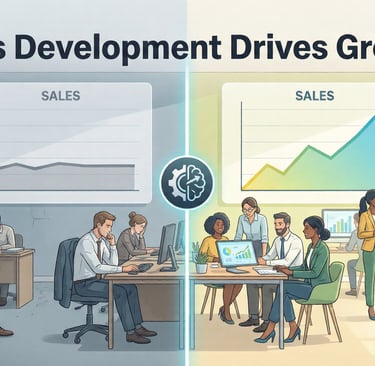
If skills development is neglected, the organisation slowly loses its ability to adapt. Sales flatten. Innovation slows. Talent leaves. What remains is a business operating on yesterday’s knowledge in tomorrow’s market.
The question leaders must ask themselves is not: “Can we afford training?”
But rather: “Are we stalling growth by neglecting it?”
Final Thought
Skills development is not an HR initiative. It is not a compliance exercise. It is not a line item to be trimmed in difficult times. It is a growth strategy. Organisations that invest in people grow people who grow the organisation. Those that don’t may survive for a while — but they rarely thrive.
Contact
Reach out for collaborations or questions
Phone
mimi@mimimasala.com
+27-82-777-5156
© 2025. All rights reserved.
Designed by Bougainvillea Studios