When Zakhele Met Artificial Intelligence: A Small Salon, A Big Shift
A powerful real-life moment in a small South African hair salon becomes a lens into how artificial intelligence can democratise opportunity — breaking language, class, and access barriers through one simple conversation in isiZulu.
Mimi Masala
1/11/20262 min read
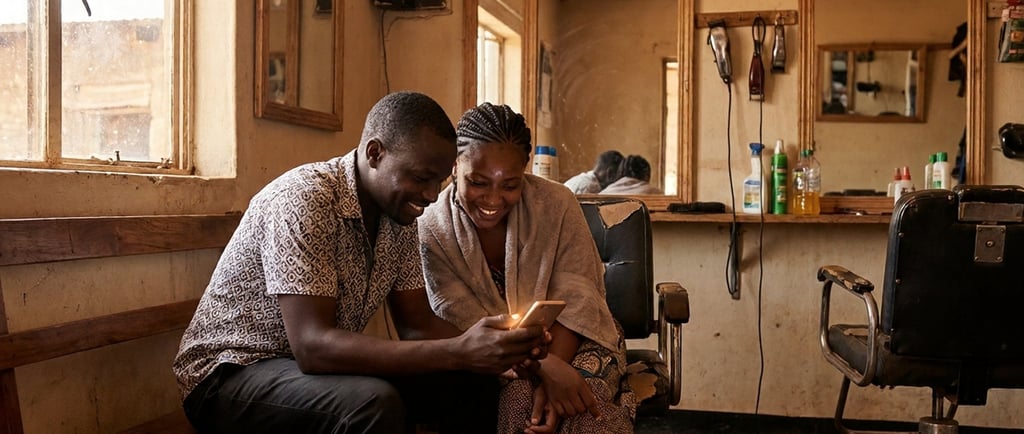
On Saturday, I found myself back in a part of town I usually avoid. The area is rough, crime-ridden, and far from comfortable — but there’s a man there who does my hair well, and sometimes quality demands compromise.
It was meant to be a goodbye visit. I told him I would be cutting my hair off completely, which meant I wouldn’t be coming back for some time. Before that chapter closed, I wanted to leave him with something more valuable than a tip.
So I brought my MacBook and a speaker. I asked him a simple question:
“Have you ever heard of ChatGPT?” He hadn’t.
That moment, that small, ordinary moment in a tiny hair salon, might turn out to be one of the most important of my year.
He was immediately concerned. “AI will destroy artists,” he said. I disagreed, passionately.
I then challenged him: Why don’t artists use AI to amplify their talent instead of fearing it?
Why assume disappearance instead of expansion?
I downloaded ChatGPT on his phone, helped him register for the free plan, and showed him where to type a question. He stood there, a proud, stoic Zulu man, unsure but curious.
Then I asked him to type something in isiZulu. Firstly, e asked ChatGPT - “Can you speak isiZulu?” ChatGPT answered him — in isiZulu, “Yebo, ngiyakwazi ukuphendula ngesiZulu. Ungangibuza noma yini.”
His face changed. That was the moment I knew something profound had happened.
In that instant, artificial intelligence stopped being something foreign, elitist, or distant. It became a voice that spoke his language — literally and figuratively. For the first time, I truly believed that AI could be the greatest democratiser of opportunity humanity has ever known.
If someone in a small, struggling, inner-city salon can ask questions in their mother tongue and receive intelligent answers… then geography, class, and privilege have just been quietly disrupted.
I played him some of the music I had created using AI. He refused to believe it was AI-generated.
He stared at me, not impressed, not amused, but unsettled. I couldn’t quite decode the expression. Maybe it was disbelief. Maybe it was fear. Maybe it was the dawning realisation that the ground beneath his industry was shifting.
Or maybe it was something far more hopeful: a man glimpsing new possibilities where he had only seen threat.
I left the salon knowing I might never sit in that chair again. But I also left knowing that something had been planted there, not just an app on a phone, but a seed of awareness.
We talk endlessly about how technology will change the world. But real change doesn’t happen in boardrooms.
It happens in places like that salon. Between clippers and mirrors. Between curiosity and fear.
Between an old way of earning and a new way of imagining.
That day, a barber met artificial intelligence. And I think both of them were changed.
Contact
Reach out for collaborations or questions
Phone
mimi@mimimasala.com
+27-82-777-5156
© 2025. All rights reserved.
Designed by Bougainvillea Studios